This blog series is made possible by a grant from the Lilly Endowment, Inc.
Curiosity is more than just knowing about something. It is about the knowledge you gain while pursuing the answer. Curiosity is the cornerstone of learning, and children have the desire to understand the world around them. When you foster curiosity, it helps prepare the child to take on an ever-changing world.
Children learn these character skills through “caught, taught, and sought” method.
Model Interest (Caught)
- Think out loud about the world around you.
- Ask open-ended questions to them.
Encourage Exploration (Taught)
- Provide simple and kid-friendly answers to children’s questions.
- Redirect the ‘why’ questions to ‘Let’s find out’ to encourage active learning.
- Introduce books and resources.
Follow the Explorer (Sought)
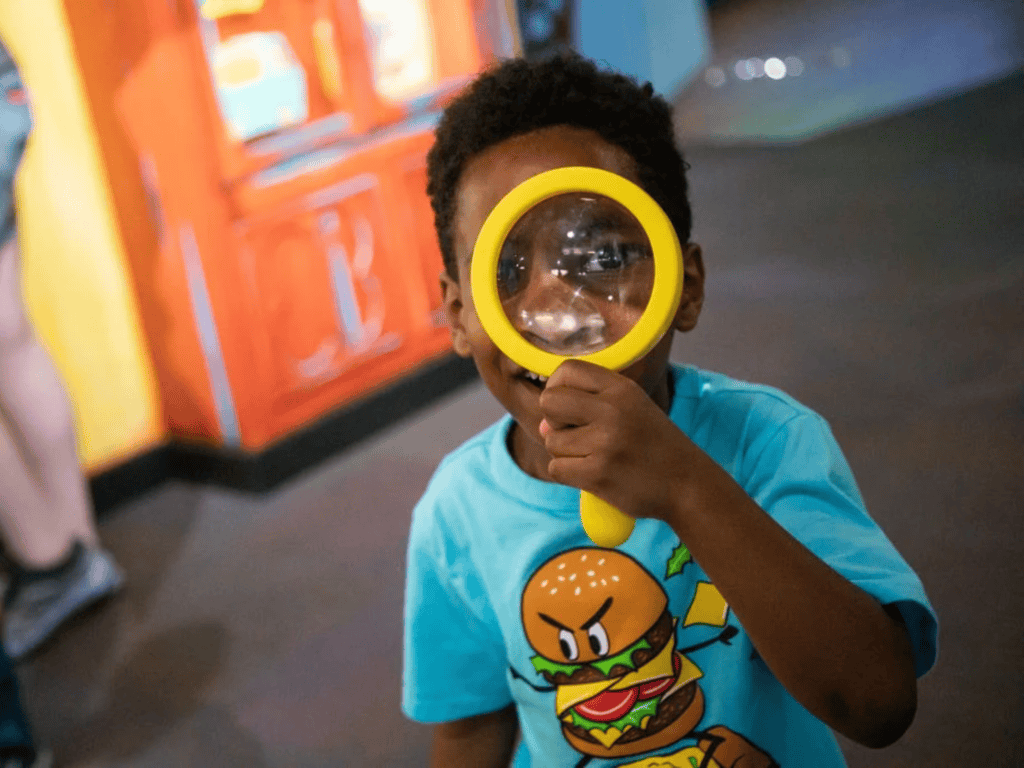
- Allow them to use their senses to learn more about the world around them.
- Follow their lead.
- Let them try things on their own
Exploring the process of learning
“Tell me, I’ll forget. Show me, I’ll remember. Involve me, I’ll understand” -Chinese Proverb
Let’s highlight Curiosity! Curiosity is a character skill that shows up at every stage of life, even during infancy. It belongs to the intellectual domain of character, which supports discernment and the pursuit of knowledge.
At Children’s Museum of Atlanta, we define Curiosity as the desire to learn more by exploring and asking questions. [1] Young children practice curiosity through exploration. In fact, exploration is curiosity in action. Under our Curiosity umbrella, there are the supporting skills of Resourcefulness and Reflection.
Resourcefulness is using familiar things in new ways to overcome challenges. When children practice Curiosity, they often rely on what they already know to explore the unknown. For example, a child may use pillows and cushions to climb on a table. The pillows are familiar objects, while climbing and seeing the room from a different perspective is the unknown. Resourcefulness becomes the tool that supports Curiosity and helps learning grow.
Reflection plays an important part in learning, too. Reflection is looking back on experiences to understand them better. It allows Curiosity to find answers and meanings. When children reflect through play, conversations, or repeated tries, the experience of learning deepens.
In the context of childhood curiosity, information gap theory is believed to be one of the motivations for Curiosity. This means that partial knowledge of a topic becomes a spark for Curiosity. [2] Reflection helps children make sense of what they have learned. Learning is a continuous cycle. So, Reflection does not mark the end of learning, but the spark that encourages Curiosity to continue.
Learning is a complex, continuous experience. Young children have the desire to learn and explore the world around them. [1] When children are encouraged to explore, adapt, and reflect, learning becomes lifelong exploration.
[1] Shah PE, Hirsh-Pasek K, Spinelli M, Ozor J, Weeks HM, McCaffery H, Kaciroti N. Ecological contexts associated with early childhood curiosity: Neighborhood safety, home and parenting quality, and socioeconomic status. Front Psychol. 2023 Feb 28; 14:986221. Doi: 10.3389/fpsyg.2023.986221. PMID: 36925599; PMCID: PMC10011070.
[2] Bjerknes, A. L., Wilhelmsen, T., & Foyn-Bruun, E. (2024). A Systematic Review of Curiosity and Wonder in Natural Science and Early Childhood Education Research. Journal of Research in Childhood Education, 38(1), 50–65.