This blog series is made possible by a grant from the Lilly Endowment, Inc.
Compassion is what connects us to those around us on both an emotional and physical level. It is going out of your way to help make someone’s life easier.
At Children’s Museum of Atlanta, we define compassion as caring about someone else’s feelings and wanting to help. Under our Compassion umbrella, there are the supporting skills of Empathy and Respect.
Kids are mini mirrors. They learn from, reflect, and imitate the kindness they see in everyday interactions. When you model empathy and compassion, even when it is difficult, the children around you are learning how to do the same.
Children learn these character skills through the ‘caught, taught, and sought” method.
Acting out emotions (Caught)
- Label your feelings aloud.
- Encourage examining behavior from people close to them.
Developing Emotional Vocabulary (Taught)
- Identify emotions in themselves and others.
- Build understanding of what those emotions mean.
- The golden rule: Treat others how you want to be treated.
Practicing Compassion (Sought)
- Describe their emotions on their own.
- Comfort sad friends around them.
Compassion’s Friend Group
“Kind hearts are the gardens, kind thoughts are the roots, kind words are the blossoms. Kind deeds are the fruits.” -Kirpal Singh
Let’s highlight Compassion! Compassion is our highlighted character skill, but there are two related skills, Empathy and Respect! Think of Empathy and Respect as Compassion’s best friends. Together, these character skills help us connect with and support the people around us. Compassion rarely works alone. It usually shows up holding hands with its best friends Respect and Empathy. Compassion is the reliable helper of the friend group. A helper is someone who gives aid to someone in need. We practice compassion when we help and support the people around us.
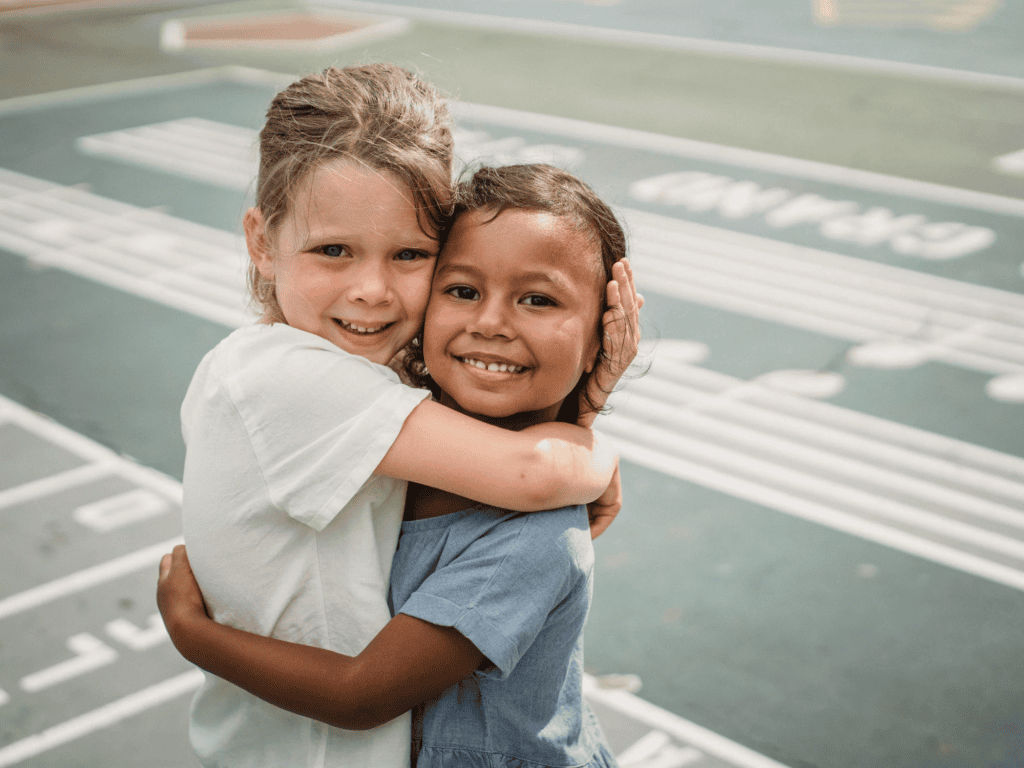
Compassion is part of the moral character domain. Moral character encourages us to respond ethically and thoughtfully to different situations. [1] Compassion can appear in small but mighty moments like a child who notices a sad friend and gives them a big hug.
Respect is not only about saying ‘please’ and ‘thank you.’ At Children’s Museum of Atlanta, we like to define respect as showing consideration and following rules for oneself, others, and the environment. It can look like sharing toys, taking turns, or cleaning up after oneself. Because respect is important across so many different cultures and communities, it can look different from person to person. Respect involves understanding different social rules and contexts within each community. [2]
Respect is the connector (also known as the networker) friend. The connector helps bring people together. Respect and Compassion work side by side to build trust and create strong, long-lasting relationships.
Empathy is sharing and understanding someone’s feelings. Children practice empathy when they recognize and name feelings in themselves and others. Babies are born with early forms of empathy, but empathy does not grow automatically. It requires intentional effort to teach and grow children into empathetic adults. Even as empathetic adults we practice it daily, too. [3]
Empathy is the warm-hearted friend. The heart of a friend group is the emotional anchor that helps everyone feel supported and understood. Empathy and Compassion work together to promote understanding and care for the many feelings in a relationship.
The compassion trio helps us stay in touch with the feelings of others and build meaningful connections. Compassion, empathy, and respect work together to remind us that actions speak louder than words. When we practice all three, we create connections between ourselves and the world. One small but mighty moment at a time.
[1] Kristjánsson, Kristján & Arthur, James. (2022). The Jubilee Centre Framework for Character Education in Schools, 3rd revised version.
[2] Khalaila R, Dasgupta J, Sturm V. The neuroscience of respect: insights from cross-cultural perspectives. Front Psychol. 2023 Dec 19; 14:1259474. Doi: 10.3389/fpsyg.2023.1259474. PMID: 38179496; PMCID: PMC10766356.
[3] Sultan MA, Khan NN. Rethinking empathy development in childhood and adolescence: a call for global, culturally adaptive strategies. Front Psychol. 2025 Aug 26; 16:1575249. Doi: 10.3389/fpsyg.2025.1575249. PMID: 40937044; PMCID: PMC12421075.