This blog series is made possible by a grant from the Lilly Endowment, Inc.
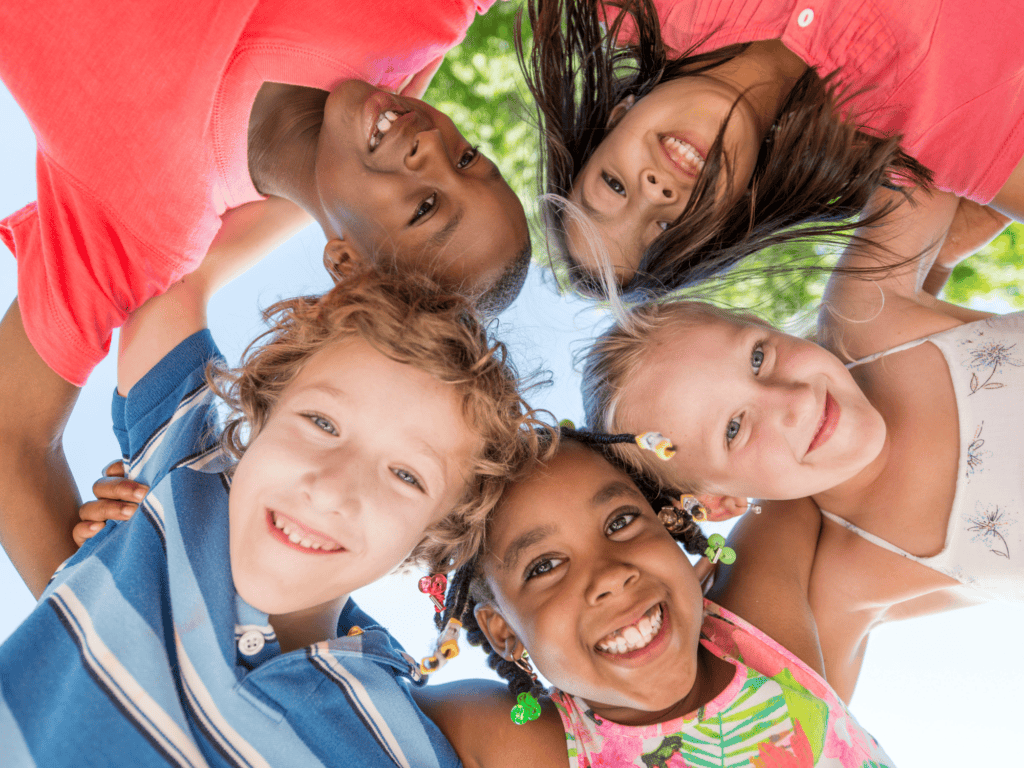
Community can help a child feel safe and help them develop social skills. Safe connections with the community for children can mean they develop a sense of belonging. Belonging leads to children growing a sense of confidence, which helps them seek more opportunities to make friends on their own. Community can be family, extended family, school, the neighborhood, and more. Community is important to support and improve relationships that you and your child share.
Children learn these character skills through “caught, taught, and sought” method.
Engage with others (Caught)
- Greet your neighbors/community members.
- Help a friend when you can.
- Attending community events like festivals, and after school activities.
Teach social skills (Taught)
- Teach and set up boundaries.
- Introduce friends, families, and neighbors.
Play together (Sought)
- Roleplaying community roles.
- Initiating conversations.
- Include children in age-appropriate conversations.
Underneath the Community Blanket
“The greatness of a community is most accurately measured by the compassionate actions of its members.”
– Coretta Scott King
Let’s highlight Community! When we talk about community at Children’s Museum of Atlanta, we are actually referring to neighborliness. Community rolls off the tongue better. Community builds a sense of belonging that fulfills a piece of the need for Love & Belonging in Maslow’s hierarchy of needs, a psychological theory that ranks human requirements from basic survival to personal growth.
Community is part of the civic domain of character. Civic character is necessary for responsible citizenship and contributing to the common good. Community happens when we create a safe and fun place to be by being friendly and helpful. Community is more than a physical place. It’s a network of people and relationships. Community begins with family and friends and extends to neighborhoods, schools, local organizations, and beyond. [1] The easiest way for children to engage with community is through their caregivers. Community is our highlighted character skill, however, there are three related skills to discuss – Teamwork, Service, and Civility.
Community is like a cozy blanket that has been stitched together. Teamwork is the thread that holds the community (and blanket metaphor) together. We use Teamwork to achieve large goals more efficiently. Teamwork builds communication, creativity, problem-solving skills, and dynamic social skills. As children practice Teamwork, they strengthen their ability to communicate, encourage one another, and build something bigger than themselves (figuratively & literally).
Service is the warmth of the community blanket. It is the choice to freely help others. Every act big and small can have a meaningful impact on others. Whether helping clean up a play space or comforting a friend, acts of service help children recognize that their actions can positively affect the people around them. When we give service to our community, it often gives in return.
Civility helps strengthen the fabric of a healthy community. It is how we show respect, kindness, and good manners toward others, while seeing the humanity and dignity of everyone. Civility influences not only how we treat people within our communities, but it is where the harmony of our communities is supported. Research suggests that civility includes both polite behavior and awareness of how our actions affect the people and spaces around us. [3]
The Community blanket brings people together. With Teamwork, Service, and Civility, we build a big, warm Community blanket together.
[1] Goerdt, L. A. (n.d.-a). Systems thinking. Macro Practice for Community and Organizational Change. https://wisconsin.pressbooks.pub/macropractice/chapter/systems-thinking/
[2] Lepicnik Vodopivec, Jurka & Hmelak, Maja. (2015). The Importance of Recognizing Roles in Teams for Higher-Quality Work in Preschools and Schools. Procedia – Social and Behavioral Sciences. 186. 1064-1074. 10.1016/j.sbspro.2015.04.054.
[3] Wilkins, Keely; Caldarella, Paul; Crook-Lyon, Rachel; and Young, K. Richard (2010) “Implications of Civility for Children and Adolescents: A Review of the Literature,” Issues in Religion and Psychotherapy: Vol. 33: No. 1, Article 8.